This is an English translation of a post I originally wrote in Persian: read the original.
The year is 1994, and the Rugby World Cup is a year away. Nelson Mandela is in his office at the presidential residence in South Africa, talking with one of the country’s sports officials. During that conversation Mandela asks him what their chances of winning the cup are, and the man answers that on paper nobody even expects the team to make it out of the first round.
After that meeting, Nelson Mandela invites François Pienaar, the captain of the national rugby team, for afternoon tea. He asks the young man sitting across from him: “François. Tell me! What is your method for leading your team?” François answers that he sets himself as the example, showing his teammates how hard they should work, as hard as he does. Nelson Mandela says: “Wonderful. It is true that this lifts the team’s strength, but that lift has a ceiling, and the ceiling is your own strength, nothing beyond it. We need to play ten times better to succeed, and I think our team needs motivation, something that moves them from the inside.” He then suggests the poem Invictus, by an English poet, to François; he tells him that this poem was the only reason he had hope, and the only reason he could bear the hard years of his 27 years in prison. He suggests that François read it with all of his teammates and keep it under their breath, so they don’t forget what they are working for.
Mandela knew very well that external motivations, the promise of money and the rest of it, could not do the job, and he knew he had to plant the seed of motivation inside the heart of each of those rugby players, not outside it. In 1995, to the disbelief of the entire world, South Africa won the World Cup.
If you are reading this, I would guess you already know a fair bit about UX. I am not saying that to flatter you. I genuinely believe we have good specialists in our country, in every one of our cities. Most of them are active people who know that there are good resources out there in the field of UX design, ready to be used. And yet, for all that technical knowledge, most of the products we build in Iran are nothing to write home about in terms of user experience, and they sit a long way behind what is being made elsewhere in the world. I think that alongside raising our technical knowledge every day, we also need a kind of inner drive. An inner drive of the same sort as the poem Nelson Mandela suggested to his national team’s captain, so that we can design user experience not merely better than we do now, but beyond what we imagine ourselves capable of.
I think what we badly need today is to make life simpler for the people doing UX design and implementation by offering them simple, graspable mental models. In this piece I want to talk about one such model, one that can move people from the inside: “love for a person.”
We know that the seed of good user experience is designing a product or a service that solves a real problem. To find people’s real problems, we have to leave our offices and get closer and closer to people. I don’t think there is a limit to how close you can get. I think you have to sit down with people and listen the way someone in love listens… go, sit, and watch how they behave for hours, until you understand what troubles them and what they suffer from. In other words, you have to love someone in order to understand their pain. Without love, I think, putting that much time and energy into finding users’ problems is more than an ordinary human relationship has the patience for.
I think that when we design user experience we should attend to detail the way a lover does. For a software product, say, let’s sit down and give ourselves the time to go back over the small, short sentences used in the messages inside the software. Let’s talk them over with our teammates and try to work out: do these sentences show how much we care about our users? Or do they show that we didn’t even bother to think about the lines we copied and pasted out of some other piece of software? Put more simply: is there any trace of our love for our users in these sentences? Or are they solemn and formal for no reason? Once we have answered those questions and changed those short sentences, let’s put them in front of our users and see whether the smile we were hoping for appears on their face. The smile that comes from “I matter to someone!”
Besides, no beloved dislikes a surprise: an unexpected gift, for no occasion at all. A handy example of such a surprise: in Gmail, if you mention an attachment in the body of your email and then forget to attach the file, Gmail tells you that it looks like you forgot it. The first time I saw that message I laughed, and said to Gmail’s designers in my head, “I love you.” Have we planned surprises like that for our users, across the different parts of the product experience?
As we know, UX design isn’t limited to making a product that is useful, and easy and enjoyable to work with. At a higher level, UX design reaches the user’s experience of the brand and of the whole process of getting and using the product, which can include the behaviour of the person selling it, or the person answering our support line. And here, since people don’t have much time to think and what is needed is a fast, correct reaction, the importance of the love-for-a-person model becomes clearer.
Let me show you why those fast reactions matter, with an example. Imagine you are in a boxing ring and your opponent throws a punch at you. In that instant you have to take in the speed and the angle of their fist precisely, that information has to travel to the brain, the brain has to interpret the data, and then it has to issue the right command to your muscles for an appropriate defensive move. If you are not a boxer, and I am not, this process inside the body takes something like half a second, and make no mistake: you will open your eyes to find yourself on the floor, because your opponent’s punch is far faster than your body’s reaction. So how do professional fighters answer their opponent’s movements so quickly? The answer lies in the patterns their bodies have formed in advance, through a great deal of practice. Their quick reaction doesn’t come from sizing up the situation and analysing it; it comes, unconsciously, out of a mental model.
In UX design at the level of the brand, at the brand’s human touchpoints, that same speed in reacting correctly to what the users of a product and a service ask for is what matters. For example, if our mental model is that we love our users, then when the phone rings we behave differently than we did before. First, we answer someone we love on the first ring. We put real energy into being the first one to say hello. We never open with “Operator 119, go ahead.” Second, even if we cannot solve the user’s problem at that moment, we listen closely to what they say, as though no one else in the world existed. I have seen many times over that simply being someone who listens can make a difference to users.
When our mental model is that we love our users, then when we run into an angry customer, instead of raising the temperature with beside-the-point remarks we try, the way a lover does with the one they love, to show that we are listening, that we are trying to understand the problem and then fix it, and that we are sorry, with everything in us, that this happened at all. Sorry the way someone truly in love is sorry for a mistake that upset the person they love, whether they meant it or not; that part doesn’t matter.
An important thing about this model is that we cannot pretend to love. We can’t put on a manufactured smile in front of the user of our product and then talk behind their back inside our own team, or even make fun of them. Let’s not underestimate people: they can tell a manufactured smile from a real one very easily, let alone at the more complicated touchpoints between a product and its user, where our hand is shown far faster. So, as in any human relationship built on love, let’s not try to fake it, because over the long run it does the opposite of what we wanted and things end up worse than before.
I think that in this short life of ours we don’t have much time to solve all the problems of all the people in the world, but we can be smart and solve the problems of the group or the part of society that we love. If I love books, for instance, and by extension have a soft spot for librarians, I will try to build a product that has something to do with that group and solves one of their problems.
Now you might ask: fine, Arash, but we already have a product or a service out there and we already have customers. Surely you don’t mean that because we aren’t head over heels in love with our customers and users, we should wave goodbye to them and go off to build a different product for a different group of people?
Let me make a confession and say honestly that until fairly recently I was not in love with librarians, and yet until early 2014 I was part of a team building library software for them. In those days I decided to test a hypothesis on a small scale. My hypothesis was that if we make the effort, we can find small things in our current customers to fall in love with too. So I tried to get closer to librarians. I tried to listen to them more. I tried to find small things in the way they behaved that I could love. One of them, for instance, was how quietly they spoke. I realised these people had this wonderful quality and that I had been oblivious to it the whole time. In fact, the closer I got to them and the better I came to know them, the more I loved them, and that loop of more knowing and more love kept going, exactly as it does in any human relationship built on love.
There is a well-known line that says: the user is the king. I think, together, we can take that one step further and say: the user is your love.
Postscript:
- This text comes from my talk at the first Tehran UX Conference in October 2013; I have published it today with a few changes.
- If the story at the start of this piece interested you, you can watch the 2009 film Invictus.
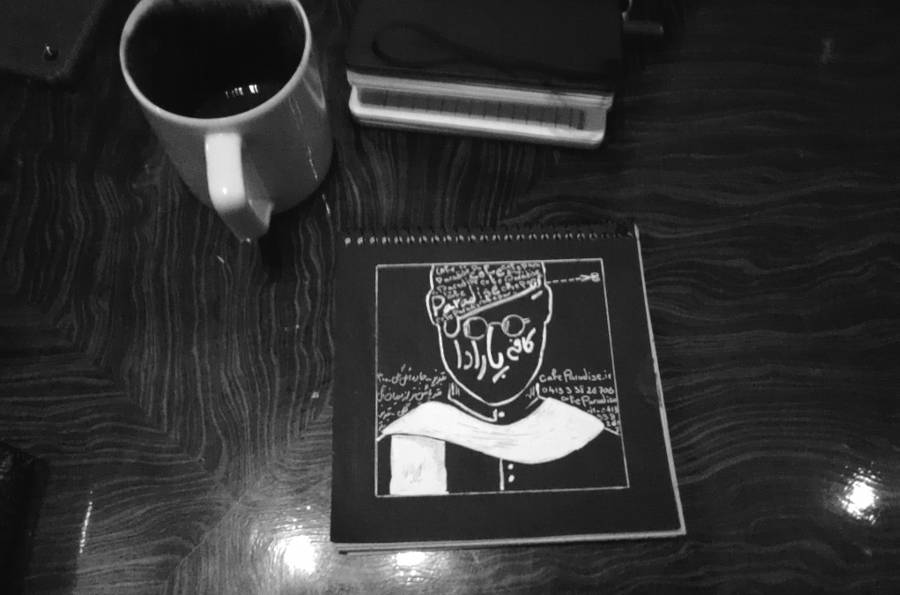
- The photo in this post is one of the menus at Café Paradis in Tabriz. They are handmade and handwritten, and at the back of the menu there are blank pages left for the customers to write on. This menu is another example of the kind of thing that puts a smile on a café’s customers’ faces.